
二語閱讀能力結(jié)構(gòu)方程模型構(gòu)建:語言、認知、情感因素
簡介
本書特色
前言
章節(jié)列表
精彩閱讀
下載資源
相關(guān)圖書
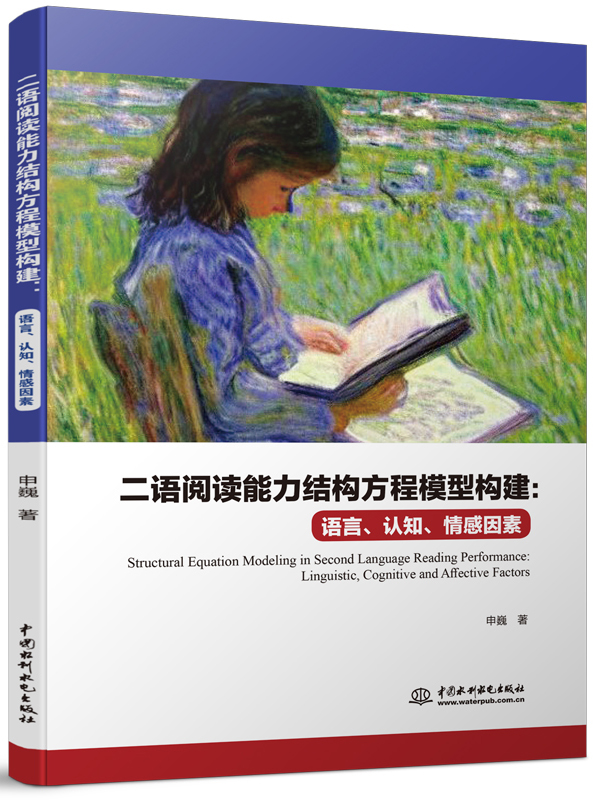
本書采取定量研究的方法,通過詞匯知識測試、閱讀策略問卷、工作記憶測試、自我效能感問卷和閱讀測試,獲得量化數(shù)據(jù),利用結(jié)構(gòu)方程模型(SEM)等統(tǒng)計工具對獲得的數(shù)據(jù)進行深挖和分析,探討第二語言(二語)詞匯知識、閱讀策略、工作記憶、自我效能感和二語閱讀理解之間的相互關(guān)系。通過構(gòu)建二語閱讀影響因素模型,試圖發(fā)現(xiàn)我國二語學習者語言因素、認知因素、情感因素影響閱讀能力的內(nèi)在機制。
本書在理論上有助于二語閱讀理論的進一步發(fā)展和完善,在研究設(shè)計和研究方法上對同類課題的開展有借鑒價值,在實踐上對我國的英語閱讀教學有啟發(fā)和指導(dǎo)作用,適合對二語閱讀理論、結(jié)構(gòu)方程模型在二語習得中的應(yīng)用等感興趣的讀者。
The findings of this study contribute to clarifying the inherent interrelationship and interaction among second language ( L2 ) vocabulary knowledge, reading strategy, working memory, self-efficacy and L2 reading comprehension with the construction of RS-VOC-WM-SELF-READ structural model, and providing theoretical and pedagogical implications for L2 reading teaching and learning.
閱讀是一項復(fù)雜的認知活動,讀者通過與文本交互獲取信息,是獲取知識、擴大詞匯量、提高思維能力、學習寫作風格的一項重要途徑。
影響閱讀理解的因素很多,從宏觀上可以分為環(huán)境因素、文本因素和學習者因素三大類別。環(huán)境因素指閱讀發(fā)生時讀者所處的環(huán)境。文本因素指文本自身具有的各種特征,如文本的呈現(xiàn)方式、類型或體裁、文本的語言特征等。學習者因素對閱讀理解的影響是指在閱讀相同的文本時,由于個體差異的存在,不同的學習者對文本的理解能力不盡相同。這些個體差異包括年齡、性別、閱讀動機、認知風格和語言水平等。就二語閱讀理解而言,學習者因素可分為三類:第一類是語言知識;第二類是在閱讀理解中普遍存在、不局限于特定語言的認知活動;第三類是情感因素。
本書研究的主要目的是揭示語言、認知和情感因素對閱讀能力影響的內(nèi)在機制。現(xiàn)有的二語閱讀研究已證實語言因素中的詞匯知識是二語閱讀能力重要的預(yù)測因素之一,同時,閱讀策略和工作記憶在認知領(lǐng)域?qū)ΧZ閱讀也起到有效的作用。情感因素中的自我效能感與二語閱讀理解之間存在正相關(guān)關(guān)系。但目前還沒有足夠的經(jīng)驗證據(jù)來確定二語閱讀過程中詞匯知識、閱讀策略、工作記憶和自我效能感在多大程度上協(xié)同作用,從而使學習者表現(xiàn)出更高的閱讀能力。
由于二語閱讀過程的多面性及語言、認知、情感因素和二語閱讀之間的復(fù)雜關(guān)系,本書采用結(jié)構(gòu)方程模型(SEM)來闡明變量之間的直接和間接聯(lián)系。SEM的優(yōu)勢在于其測量模型能夠提高多指標變量的量化效度和信度,其結(jié)構(gòu)模型能夠?qū)⒍鄠�變量同時處于一個框架中,直觀地展現(xiàn)它們之間的復(fù)雜關(guān)系。本書選擇 SEM 進行數(shù)據(jù)分析,實際上是對二語閱讀表現(xiàn)的歸因因素的全面理解。
本書基于社會認知理論,通過厘清影響二語閱讀的個體因素,構(gòu)建二語閱讀影響因素模型,旨在探討二語學習者在二語閱讀中的詞匯知識、閱讀策略、工作記憶和自我效能感等內(nèi)在因素的相互作用,進一步嘗試為二語閱讀教學提供有效途徑。
本書是在作者博士論文的基礎(chǔ)上修改和潤色而成。由于作者水平有限,書中的疏漏之處在所難免,懇請同行和學者不吝賜教。
作 者
2022年9月
前言
Chapter 1 Introduction 1
1.1 Background of the study 2
1.2 Purpose of the study 5
1.3 Research questions 6
1.4 Significance of the study 7
1.5 Organization of the study 8
Chapter 2 Theoretical foundation 10
2.1 The concept of reading 10
2.2 L1 and L2 reading differences 12
2.3 The process of reading 13
2.4 Construction-integration (C-I) Theory 17
2.5 Social Cognitive Theory 19
2.6 Summary 21
Chapter 3 Review of Previous Studies 22
3.1 Vocabulary knowledge in L2 reading 23
3.2 Reading strategies in L2 reading 26
3.3 Working memory in L2 reading 29
3.4 Self-efficacy in L2 reading 35
3.5 Establishment of a theoretical framework 39
3.5.1 The theoretical framework of L2 reading 39
3.5.2 Hypotheses of this study 42
3.6 Summary 43
Chapter 4 Methodology 46
4.1 Research design 46
4.1.1 The design of quantitative method 46
4.1.2 Participants 47
4.1.3 Research instruments 50
4.1.4 Pilot study 55
4.2 Data collection 56
4.3 Data analysis 58
4.3.1 Statistical analysis 58
4.3.2 Descriptions about Structural Equation Modeling 61
4.4 Summary 64
Chapter 5 Results 65
5.1 Preliminary analysis 65
5.1.1 Screening outliers 65
5.1.2 Reliability of SELF and SORS 65
5.1.3 Validity of SELF and SORS 66
5.1.4 Confirmatory factor analyses in five measurement models 70
5.2 Descriptive analysis 74
5.3 Interrelationships between variables 76
5.3.1 Modeling the structural relationships 77
5.3.2 Mediating effect of self-efficacy 87
5.4 Summary 88
Chapter 6 Discussion 89
6.1 The general status of independent variables 89
6.1.1 The general status of L2 vocabulary knowledge 90
6.1.2 The general status of reading strategy 92
6.1.3 The general status of working memory 94
6.1.4 The general status of self-efficacy 95
6.2 The interrelationships between variables 97
6.2.1 The correlation between L2 vocabulary knowledge and reading strategy 97
6.2.2 The correlation between L2 reading strategy and working memory 98
6.2.3 The correlation between L2 vocabulary knowledge and working memory 99
6.2.4 The correlation between L2 vocabulary knowledge, reading strategy,
working memory, self-efficacy and L2 reading 100
6.3 Indirect effect of self-efficacy in L2 reading 104
Chapter 7 Conclusion 107
7.1 Major findings 107
7.2 Pedagogical implications 108
7.3 Limitations and suggestions 111
7.4 Summary 113
References 115
Appendices 142
Appendix A 142
Appendix B 144
Appendix C 147
List of Abbreviations 149
List of Tables 150
List of Figures 151
- 零基礎(chǔ)玩轉(zhuǎn)國產(chǎn)大模型DeepSeek [徐永冰 張帥 編著]
- 網(wǎng)絡(luò)工程師5天修煉(適配第6版考綱) [主編 朱小平 施游]
- 信息系統(tǒng)項目管理師考試32小時通關(guān)(適用第4版考綱) [薛大龍]
- 信息系統(tǒng)管理工程師考試32小時通關(guān)(適配第2版考綱) [薛大龍 劉偉]
- 土木工程材料檢測實訓(xùn) [洪曉江 達則曉麗 錢波]
- 科技信息檢索與論文寫作實用教程 [李振華]
- 傳統(tǒng)山水畫論解讀與實踐 [陳鈉 著]
- Python數(shù)據(jù)庫編程 [主編 殷樹友 邢 翀]
- 計算機基礎(chǔ)實訓(xùn)指導(dǎo) [主編 袁春萍 朱妮]
- 嵌入式人工智能技術(shù)應(yīng)用(數(shù)字教材) [主編 胡娜 楊國勇 晏廷榮]
- Vienna整流器技術(shù) [桂存兵 著]
- 變頻器與伺服應(yīng)用 [陳剛 葉云飛]
- 物聯(lián)網(wǎng)工程設(shè)計與實踐 [湯琳 李敏]
- 爐邊夜話——深入淺出話AI [汪建 著]
- 電商運營與管理 [鐘肖英 陳瀟]
- Java面向?qū)ο蟪绦蛟O(shè)計 [主編 姜春磊 陳虹潔]
- 信息技術(shù)基礎(chǔ)(Windows 10+WPS Office)(微課版) [主編 石利平 田輝平 謝盛嘉]
- 人工智能應(yīng)用 [主編 陳 萍 劉培培 陳孟軍]
- 大學生職業(yè)發(fā)展與就業(yè)指導(dǎo) [主編 劉志堅]
- 高級辦公應(yīng)用項目教程 [主編 屈晶 趙成麗]
- 微信小程序開發(fā)項目實戰(zhàn)(微課版) [主編 黃龍泉 郭峰 朱倩]
- 企業(yè)檔案工作實戰(zhàn)寶典百問百答 [華俊 盧秀英 邵甜甜 著]
- 計算機網(wǎng)絡(luò)原理及應(yīng)用 [主編 唐繼勇 葉坤 孫夢娜]
- 大學生創(chuàng)業(yè)基礎(chǔ) [主編 王麗莉 王 楊]
- 船舶輔機 [主編 王連海 于洋 姜淑翠]
- 大學生就業(yè)指導(dǎo) [主編 王麗莉 董宴廷]
- 系統(tǒng)架構(gòu)設(shè)計師章節(jié)習題與考點特訓(xùn) [主編 薛大龍 鄒月平]
- 高校學生工作探索與實踐 [郭亮 著]
- 大學生情商管理 [方雄 著]
- 2023年長沙市會展業(yè)發(fā)展報告 [主編 周棟良]